
Hello!
October showed how fast an AI upload becomes a breach. After Training Data Guardrails in September, this month we look at AI Usage Guardrails: using ChatGPT, Gemini and Claude without sending customer records, credentials or deal terms along with the prompt.
A quick round-up:
- Two Gartner inclusions in one month: Mage Data is now in Gartner’s Market Overview reports for Data Security Platforms and Data Masking and Synthesis
- One upload, 3,182 letters: a hospital worker uploaded patient data into an unapproved AI tool
- The middleman kept everything: an AI aggregator left 17.6 million files in an open bucket
- Mask it before it leaves the browser: AI Usage Guardrails masks prompts and uploads before they are sent
Gartner Covers Mage Data in Two Markets
Gartner has included Mage Data in its Market Overview reports for Data Security Platforms and for Data Masking and Synthesis: one for the platform market, one for the masking market Mage Data has worked in for over a decade. They join Mage Data’s inclusion in Forrester’s Data Security Platforms Landscape, Q3 2026.
See all analyst recognitions
When the Upload Was the Breach
Johns Hopkins notifies 3,182 patients after an upload to an unapproved AI tool
A Johns Hopkins Bayview Medical Center staff member uploaded a spreadsheet of patient data to a public AI tool the hospital had not approved. It held names, medical record numbers, account numbers, treatment dates and medications. The hospital asked the AI vendor to delete its copy and began writing to patients on 22 October.
Source: Becker’s Hospital Review
How to keep this out of your organisation
- Check the file, not just the prompt. One upload can carry a whole table. Scan attachments for names, record numbers and account numbers, and mask them before they are sent.
- Do not rely on the vendor to delete it. Once a file is uploaded, all you can do is ask someone else to erase it. If it was masked first, there is nothing to recall.
- Know which AI tools are in use, approved or not. You cannot answer an auditor from a list of the tools you meant to allow.
AI Usage Guardrails | Activity Monitoring for AI
The Middleman Kept Everything
302.ai storage bucket exposed 17.6 million AI files
Cybernews found an unsecured Azure bucket belonging to 302.ai, an aggregator that fronts many AI models through one API: about 17.6 million chat logs, uploaded documents and personal data, including logs from a company’s customer-support chatbot. That company’s customers had no way of knowing a middleman kept a copy.
Source: Cybernews
How to keep this out of your organisation
- Add AI intermediaries to third-party review. For every tool and the gateways behind it: where is prompt data stored, for how long, who can read it, does it train models.
- Send less, so there is less to lose. A support bot does not need a full account number to answer a delivery question. Mask identifiers first.
- Find the AI-adjacent copies you already hold. Prompt logs, transcripts and vector stores rarely make the inventory. Scan them like databases.
Data Discovery & Classification | AI Usage Guardrails | Static Data Masking
Mask It Before It Leaves the Browser
AI Usage Guardrails
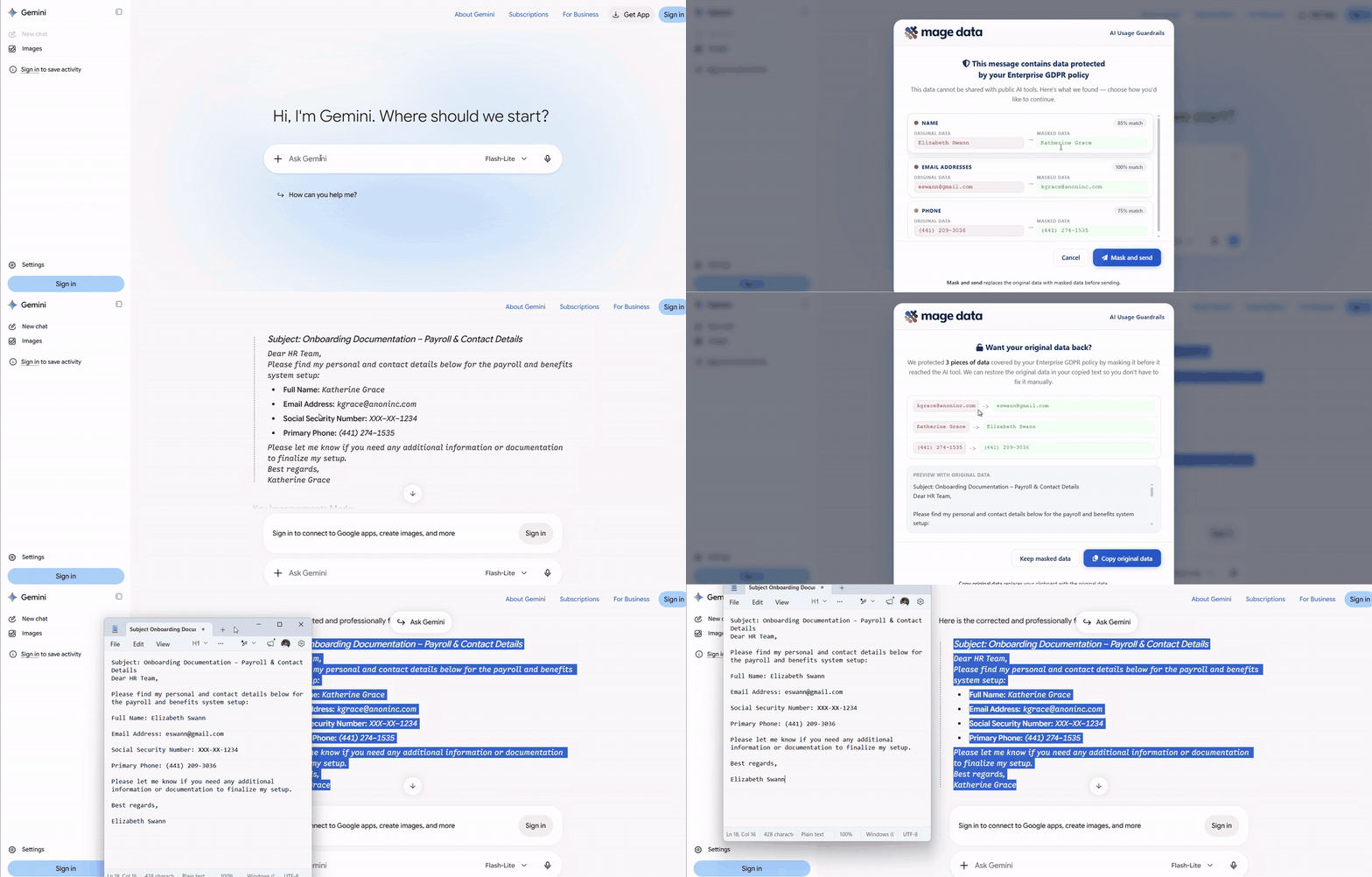
- What it does: A browser extension and endpoint agent check prompts and uploads to ChatGPT, Gemini, Claude and others for names, tax IDs, account numbers, credentials and source code, using the same classification engine as the rest of the Mage Data platform.
- How it works: The employee gets a masked version and carries on. An override sends the prompt and logs it for employee and admin. Activity Monitoring for AI keeps the record across tools, approved or not.
- Why it matters: Blocking pushes people to personal accounts, where you see nothing. Masking keeps work moving, and the log is the evidence MAS and your auditors will ask for.
See how AI Usage Guardrails works
Check out the other AI capabilities in Data Security and Privacy for AI.
Short Reads
-
How to Meet Singapore’s New AI Guidelines? Start With Your Data Layer
New this month. What MAS expects of your data, and where to start before October 2027. -
Training Data Guardrails: keeping sensitive values out of the model
Missed it in September? Once sensitive data is inside a model, you cannot reliably take it out.
Breaches don’t wait for a monthly newsletter. Neither does SecureFact™. Get the week’s biggest breaches, fines and security stories in your LinkedIn feed. Subscribe on LinkedIn
Want your people to use AI without sharing sensitive data? Book a 30-minute demo